
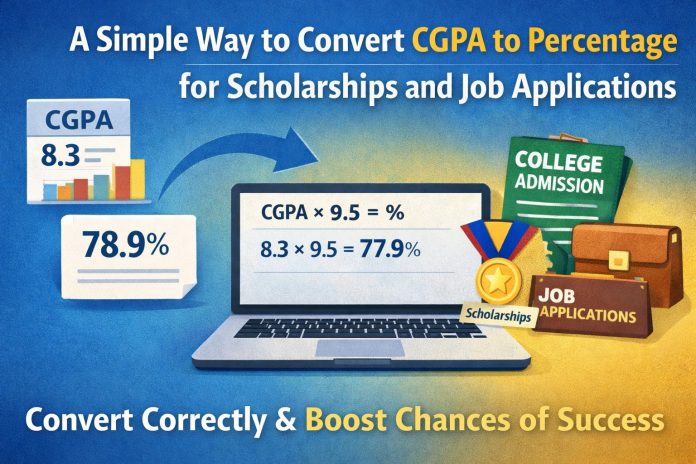
Students often face one common problem. Their transcript shows CGPA, but application forms ask for percentage. This small difference creates stress.
Scholarships and job portals usually require marks in percentage format. Many students feel confused about how to convert their CGPA correctly. A wrong number can hurt an application.
Why Scholarships and Employers Ask for Percentage
Many institutions still use percentage as a standard format. Scholarship boards compare students from different universities. Percentage makes that comparison easier.
Employers also prefer percentage because it looks simple and direct. Human resource teams review many resumes each day. A clear percentage helps them screen candidates faster.
CGPA uses a grading scale. Percentage uses marks out of 100. Both systems measure performance, but they look different. That difference leads to mistakes during conversion.
If your form asks for percentage, you must not guess. You must convert your CGPA based on the correct formula. Accuracy shows honesty and professionalism.
How to Convert CGPA to Percentage Correctly
The first step is to check your university rule. Many universities follow this formula:
Percentage = CGPA × 9.5
Some institutions use 10 as a multiplier. Others follow a custom rule. You must confirm the official method.
Let us see an example.
Suppose your CGPA is 8.4.
If your university uses 9.5 as a multiplier:
8.4 × 9.5 = 79.8%
Your percentage becomes 79.8%.
This method looks easy. Still, many students make small errors. Some use the wrong multiplier. Some round the number too early. Others forget to check their university policy.
Manual math also takes time. You may need to convert marks more than once. Scholarship forms, job portals, and exam registrations often ask for percentages again and again.
A simple solution helps reduce stress. One practical option is to use a CGPA to Percentage Calculator.
This type of tool applies the formula instantly. You enter your CGPA. The calculator shows your percentage in seconds. It removes doubt and saves time.
You still need to confirm your university’s multiplier. Once you know the rule, a calculator gives you a fast and clear result.
Why Accuracy Matters in Applications
Scholarships often have strict eligibility criteria. Some require a minimum of 75% or 80%. If your calculation looks wrong, you may appear ineligible.
Job applications also set cut-off marks. Many companies filter candidates based on academic scores. An incorrect percentage may push your resume out of the shortlist.
Verification teams sometimes compare submitted data with official transcripts. A mismatch may raise questions. You do not want delays during document review.
Correct numbers reflect your true performance. They also protect your credibility.
Students sometimes rely on rough estimates. That approach can backfire. Even a small difference of one percent may change eligibility.
Use a clear formula. Double-check your result. Present your marks with confidence.
Common Errors Students Make
Many students assume all universities use the same rule. That assumption leads to mistakes. Each institution may follow a different multiplier.
Some students convert CGPA without checking decimal points. Rounding too early can change the final figure.
Others copy formulas from friends or online forums without verification. That creates confusion.
Another mistake is typing the wrong number during manual calculation. A simple typing error can lead to a wrong percentage.
A calculator reduces these risks. It handles multiplication accurately. It gives a quick result that you can review before submission.
You still remain responsible for checking your university’s official guideline. A tool supports you, but it does not replace official instructions.
When You Need Quick Conversion
Scholarship deadlines often come close to the last date. Job applications also have strict time limits. You may need to fill multiple forms in one day.
In such cases, speed matters. You cannot spend time solving the same equation again and again.
A quick conversion tool helps you stay focused on other important details. You can prepare documents, write statements, and update your resume without stress.
Clear academic details strengthen your profile. Accurate percentage marks show discipline and attention to detail.
Keep Your Academic Profile Clear and Honest
Your marks represent years of hard work. Present them clearly. Use the correct format when required.
Check the formula approved by your university. Convert your CGPA carefully. Review the result before you submit any form.
A small step today can prevent problems later. Accuracy builds trust. Trust supports your application.
Scholarships and job opportunities depend on many factors. Academic performance remains one of the key elements. Make sure your marks reflect your true effort in the right format.
