
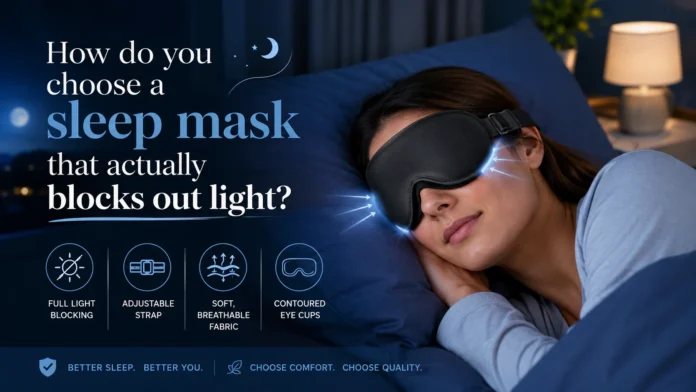
Most people who say sleep masks do not work for them have simply owned the wrong one. The free airline version, the thin pharmacy strip, the promotional giveaway: these all share the same flaws, and they have given a genuinely useful sleep tool a bad reputation. A well-designed mask creates real darkness, which matters because even small amounts of light in the bedroom can interfere with how quickly you fall asleep and how deeply you stay there. Here is what separates a mask that works from one that ends up in a drawer.
Why do most sleep masks fail?
The answer is almost always the same: the nose. The gap where the mask meets the bridge of your nose is where light sneaks in, and it is exactly where your eyes point when you lie on your back. A mask can be made of the thickest fabric in the world and still fail if it leaves that channel open.
The second common failure is thinness. A single layer of fabric pressed flat against the eyelids lets light glow through, especially in a bright bedroom at 6 am in summer. When it comes to choosing a silk eye mask or any other style, thickness and structure around the nose should be the first two things you inspect, well before colour or price.
The third failure is the strap. Elastic that is too loose lets the mask slide off during the night; elastic that is too tight presses on the temples, causes headaches and, ironically, creates new gaps by deforming the mask.
What design features make the difference?
Generous padding is the simplest fix for both light leakage and comfort. A thick, cushioned mask moulds itself around the bridge of the nose and the contours of the face, closing the gaps a flat strip cannot. Some designs push this further with a dedicated nose baffle, a small flap of fabric that seals the bridge specifically.
Width matters too. Wraparound masks shaped like a wide band cover a larger area of the face, stay in place when you move, and block the peripheral light that narrow masks let in at the temples. For restless sleepers, that extra surface is often what keeps the mask on until morning.
Contoured masks with moulded eye cups are the other main school. They keep all pressure off the eyelids and lashes, which some people find more comfortable, at the cost of extra bulk on the face.
Does the material really matter?
More than most buyers expect. Your mask spends seven or eight hours a night pressed against the thinnest skin on your body, so breathability and friction count. Polyester masks tend to trap heat and can irritate sensitive skin over time. Natural fibres like cotton and, above all, silk stay cooler and glide over skin rather than tugging at it.
With silk, the number to check is the momme, which measures the fabric’s density. Anything from 19 momme upward is considered good quality; the premium end of the market, such as the padded masks from Drowsy Sleep Co, uses 22 momme mulberry silk over deep cushioning, combining the blackout benefits of thick padding with a surface that is gentle on skin and hair. Whatever the brand, thick padding plus a smooth natural fabric is the combination to look for.
How do you get the fit right?
Snug, not tight, is the rule. Adjust the strap until the mask stays put when you turn your head, then stop. If you can still see a glow, reposition the mask on the nose before reaching for the strap again, because most residual leaks are a placement problem rather than a tension problem.
Your sleeping position should influence the choice too. Back sleepers can wear almost anything. Side sleepers need a mask that does not bunch up between face and pillow, so a soft, flexible padded design usually beats a rigid contoured one.
Test the mask properly before judging it. Put it on in a lit room, look toward the light source, and check the nose area and the temples. A mask that passes that test in daylight will handle a street lamp or an early sunrise without difficulty.
What about hygiene and lifespan?
A sleep mask absorbs skin oils, creams and serums night after night, so washability is not a detail. Check that the mask is fully washable and follow the care instructions, particularly for silk, which prefers gentle hand washing. A cared-for quality mask lasts years; a neglected one becomes something you no longer want on your face.
Choose on those criteria, thickness, a sealed nose area, a wide secure fit, a breathable natural fabric and easy washing, and a sleep mask stops being a travel gadget and becomes one of the cheapest sleep upgrades available. Total darkness every night, wherever you happen to be sleeping, is a modest luxury that pays for itself remarkably fast.

